Robert Kiyosaki & Garrett Baldwin
The Insiders Know
What's Coming Next.
Now You Will Too.
The most powerful investors in the world leave a legal paper trail — and we follow
every move before the market catches on.
From $1,000
Because this is not how I usually operate.
In fifty years of investing, I have made my career on a small number of principles. The most important one came from my Rich Dad.
He used to say it to me until I memorized it.
Don't listen to what people say. Watch what they do with their money.
That principle is the reason I am sitting here.
Because in the last several months, I have been watching what some of the most informed people in the world are quietly doing with their money in one specific region of the United States.
And what I have seen has changed the way I am spending my time.
You already know the broad outlines.
You read the lithium report. You watched the briefings.
You know that there is a federally protected zone in the eastern United States where transmissions are restricted by law.
You know that some of the most patient capital in the world — American pensions, Canadian infrastructure groups, sovereign wealth tied to the new Abu Dhabi partnership has been quietly accumulating in this region, in coordinated waves, in the same companies.
You know that the man who connected those dots is the most disciplined analyst I have worked with in fifty years.
What I want to tell you, before Garrett walks you through the specifics, is why I have decided to put my own name on this work.
My phone is, in my honest opinion, the most valuable thing I own.
Not because of what it costs. Because of who is in it.
Over five decades, I have built relationships with people who see the world before it shows up in the news. Founders. Investors. Senators. Two presidents.
People who, when they pick up the phone, are not telling me what they read — they are telling me what they are about to do.
That access has been the engine of every good decision I have made in this business.
And the reason I am working with Garrett — the reason his work is the foundation of what we built together — is that he has constructed a way to give the same kind of access to ordinary investors.
Without the dinners. Without the private clubs. Without the million-dollar memberships.
His system reads what informed people are doing with their money in public filings, available to anyone who knows where to look and identifies, with discipline when those movements are signaling that something is about to happen.
Eighty-three percent of the time, over the last twelve months, those signals have produced winning trades.
Cumulatively, six hundred and twelve percent.
Past performance does not guarantee future results. Garrett knows this. I know this. You should know this.
But discipline of that kind, sustained across that many trades, is not luck.
It is method.
In a moment, Garrett is going to tell you everything.
He is going to walk you through the company at the center of this opportunity. He is going to show you the filings he studied to find it.
He is going to explain why the location matters. Why the capital flow matters.
And why, in his judgment and mine, this may be the cleanest setup we have seen in months.
He is also going to walk you through the research service we built together — what we call Kiyosaki's Inside Track and what charter membership means for the next twelve months of his work.
I want to ask one thing of you before he begins.
Listen the way you would listen to a friend who knew something you didn't.
Take the hour. Hold the questions until the end. Then make the decision that is right for you.
If the answer is yes, I will be glad you joined us.
If the answer is no, I respect that — and there will be more research from me worth your time.
Either way — thank you for spending this week with me.
Now, I’d like to give the floor to Garrett.
Thank you, Robert. Hello, everyone. My name is Garrett Baldwin.
I'm really excited to bring you in and show you how we're able to target big stock market wins in pretty short time frames.
I think you'd agree with me that if you could just copy the trades of the most successful traders in the world, you'd be able to make a fortune, right?
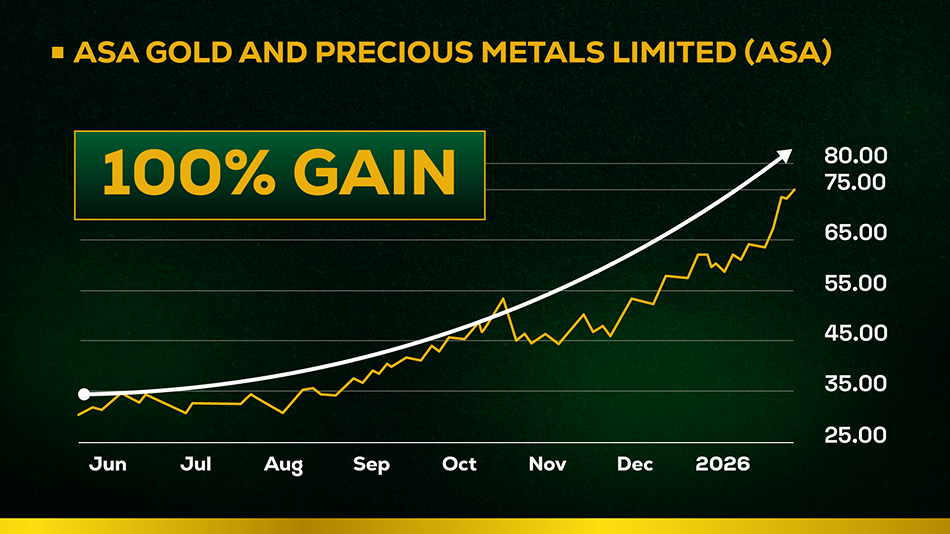
I'm talking about trades like these. Take a look. A 100% win on ASA Gold and Precious Metals (ASA).
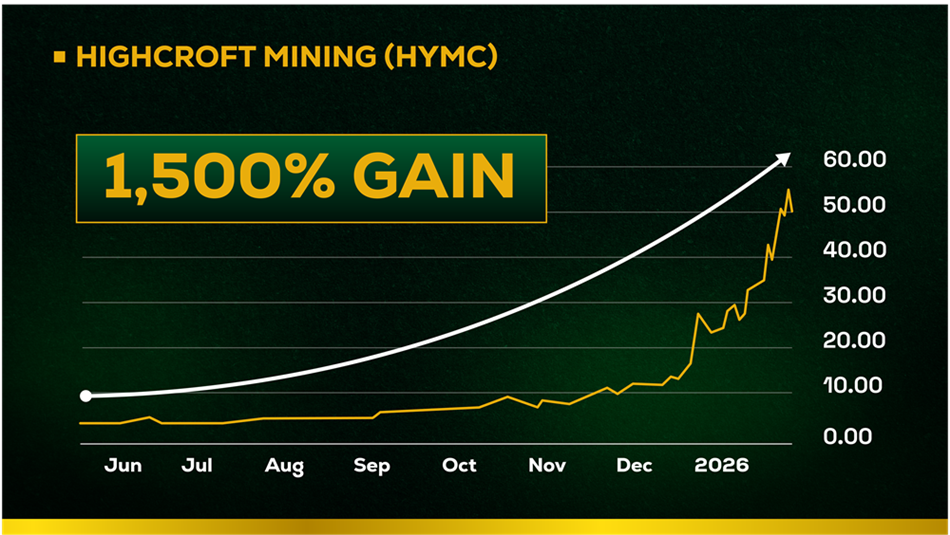
A monster, 1,500% gain on Highcroft Mining (HYMC).
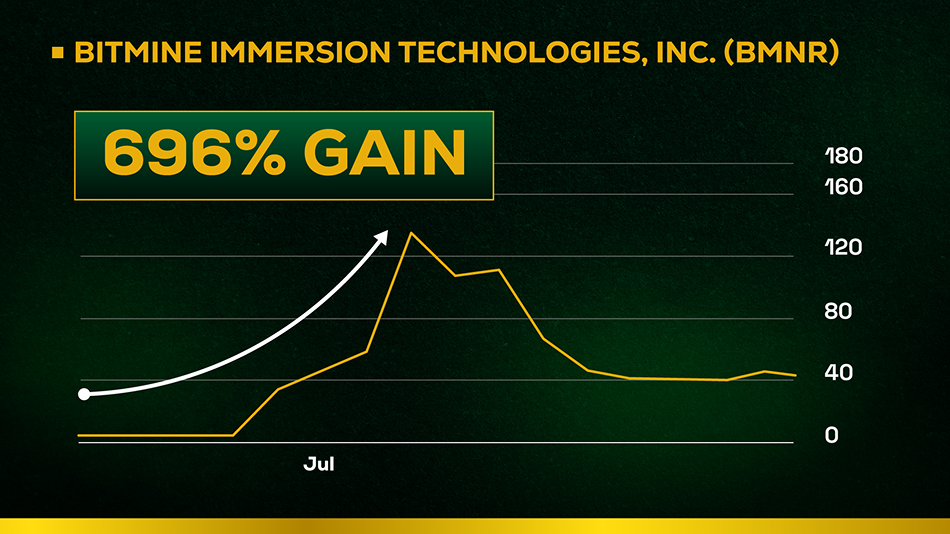
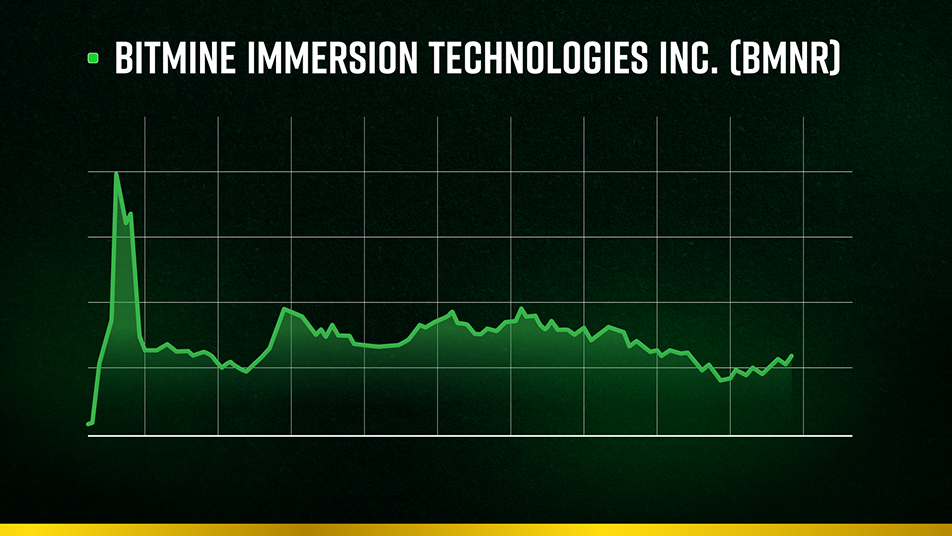
And this giant payday with Bitmine Immersion Technologies (BMNR), a 696% moonshot in just weeks.
Don't you wish you could have copied those trades?
Well, you can because each one of those examples are the trades of CEOs, CFOs, other executives, and board members who bought their own company's stock with their own personal money.
Or they're really large money funds, or even other companies who have huge stakes already invested and decided to kind of double down and put even more money in.
It's totally legal for them to do that. And they even have to file an online form letting the public know they're doing it.
Here's one that Elon Musk had to file. It shows you their name, how much of their own stock they're buying, and other details of the trade.
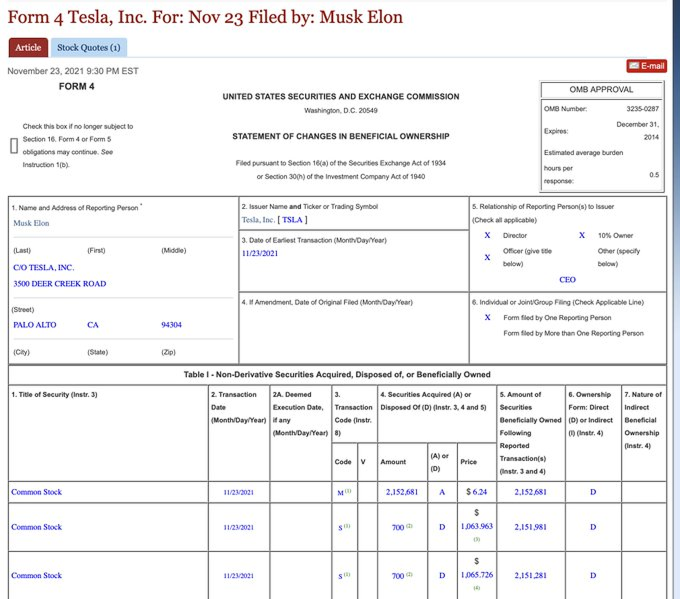
And that form is available for anyone to see on the Securities and Exchange Commission's website . And it's totally legal for you to copy those trades.
Just a minute ago, we agreed that you could make a fortune by following the trades of the most successful traders in the world, right?
Well, the people who are high up in these companies just so happen to actually be the best traders in the world — those gains I just mentioned.
The 100% win on ASA came right after Boaz Weinstein, a beneficial owner of the company, bought more than $46 million worth of shares.
The 1,500% win on Highcroft Mining happened after a company insider named Eric Sprott dropped $49,985,000 of his own money into the stock — almost 50 million bucks.
And now he's sitting on a $27 million profit. If you think that's wild, check this one out.
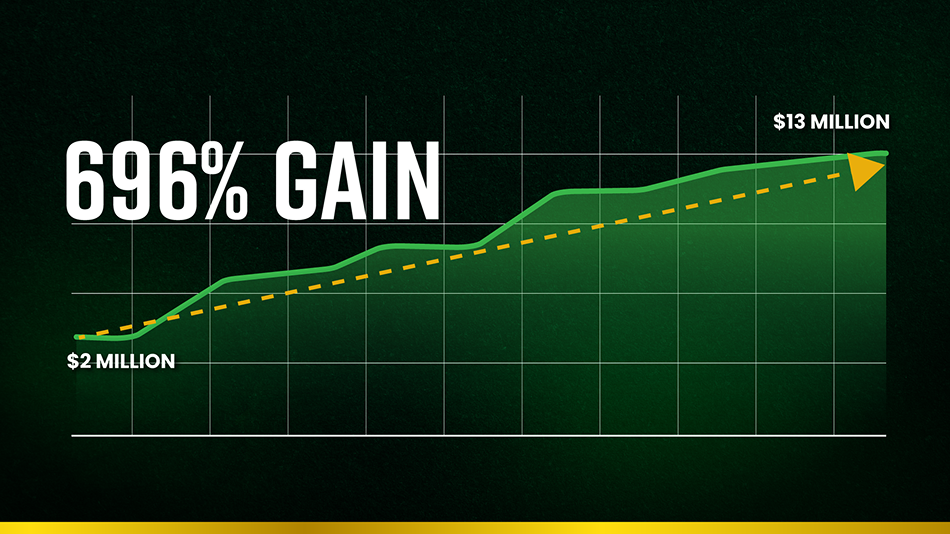
That monster 696% cash grab on Bitmine Immersion Technologies came right after company director Lee Thomas Jong plunked down $2 million.
And now he's pocketing a profit of $11,431,999. These are not professional traders or money managers or hedge fund analysts.
These are the people who know their own company inside and out. CEOs, CFOs, vice presidents, board members. So they know their company better than any analyst ever could.
That's why when they buy their own stock, the share prices can routinely shoot up five, ten, even twenty times higher or more.
Robert talked earlier about having an inside track.
These company insiders obviously have one.
And you can have it too.
Because each of those trades I just went over — I wrote about them in real time as they happened.
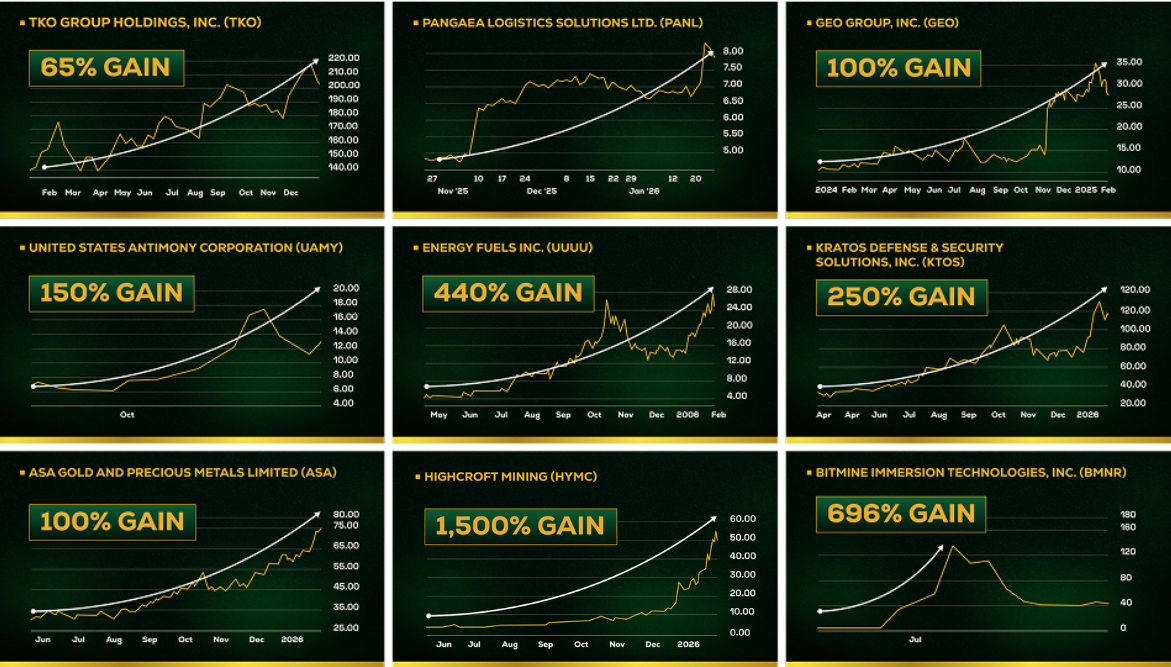
To the small group of people who I've been sharing my research with.
And anyone who copied those trades could have made a fortune.
Just $1,000 put into the first trade — and profits rolled into each trade after — would have turned that initial $1,000 into $14,332 in just a few months.
Once you know how to do this, you'll see that it's not very complicated. I'm sure you've heard the phrase, "follow the money." That's basically what we're doing.
It's how we start. But it's really important that you don't follow all the money.
If making money in the stock market were as simple as pulling up the SEC website and just piggybacking on those insider trades, everyone would be rich.
The first issue is the website itself. It's pretty clunky.
You actually have to search manually, one stock at a time, then dig through all of the public filings to find the forms.
And there are around 4,700 forms submitted every day. That would take hundreds of hours to do.
And even if you could somehow sort through all those forms, you'd be left with a gigantic pile of questions.
Because knowing what trades to ignore is just as important as knowing which ones to follow.
For example, a lot of executives get stock options as compensation. When the deadline approaches, they convert those options into shares and sell.
It shows up on the tape as a buy, but it's not a buy at all. It's just a cash out.
There's zero conviction in that kind of transaction, so we ignore it. Same thing with routine regular purchases.
If a CFO buys 10,000 shares every year on the same date, like clockwork, that's just bookkeeping. There's no signal in it, so it gets thrown out.
I also filtered out the tiny buys. A CEO picking up five grand worth of stock isn't telling you anything.
But when a mid-level director puts half a million dollars of his own cash on the line, that's different. That's someone making a real bet with real money.
And that's the kind of activity you pay attention to. Company insiders only pull the trigger when they believe they have a clear edge.
Maybe earnings are going to be stronger than Wall Street thinks. Maybe there's a merger coming that hasn't hit the news yet. Maybe an FDA decision is about to land.
Whatever the reason, they're not guessing. They're spending their own personal money, actual cash out of their own pocket. They're putting their own money on the line.
And they only do that when they see a clear advantage and they're pretty confident they know what's coming next. So here's what we're looking for.
Take the stock we went over earlier, BMNR.
I was sitting in my home office on a Tuesday morning, scrolling through the SEC files as usual, when I noticed a bizarre action on the stock.
It had been getting hammered for weeks, bleeding out like a stuck pig. Everyone was running for the exits.
But a blip in the SEC filings told a different story.
A company director named Lee Thomas Jong had just filed a Form Four.
Revealing he bought $2 million worth of stock in a company that, to everyone's eyes but his, was dying into the red.
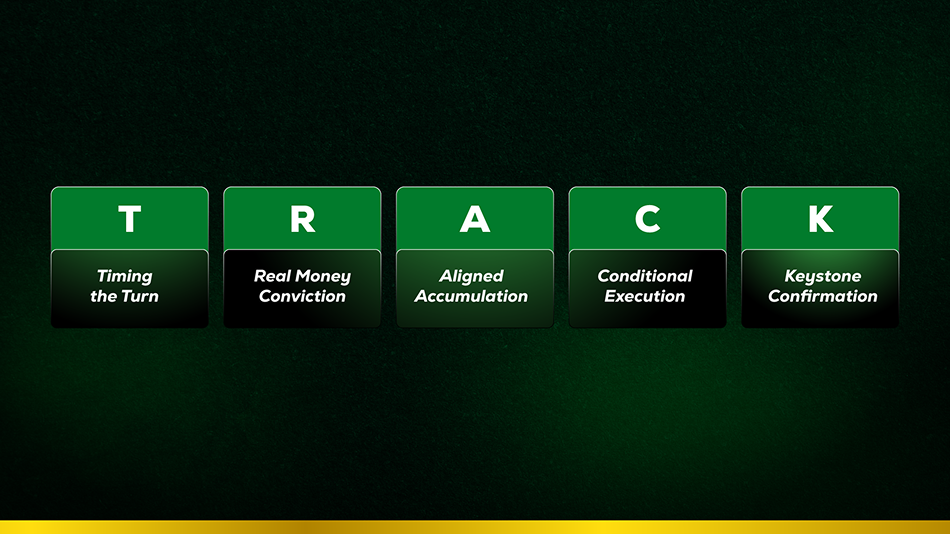
That was the first piece, timing the turn.
With all my years in corporate espionage, you know, when I see something suspicious, I know there's usually an even bigger story going on. So I kept digging.
I pulled up Lee Thomas Jong's background. Mid-level director, not a billionaire, not someone who could lose $2 million and not feel it.

This was a massive bet for this guy. Maybe he took out a loan on his house for the cash for this trade.
I ran the numbers and you know, while any financial adviser worth his salt will recommend no more than 1% of your investment fund into a single trade, that $2 million was roughly 60% of his annual compensation.
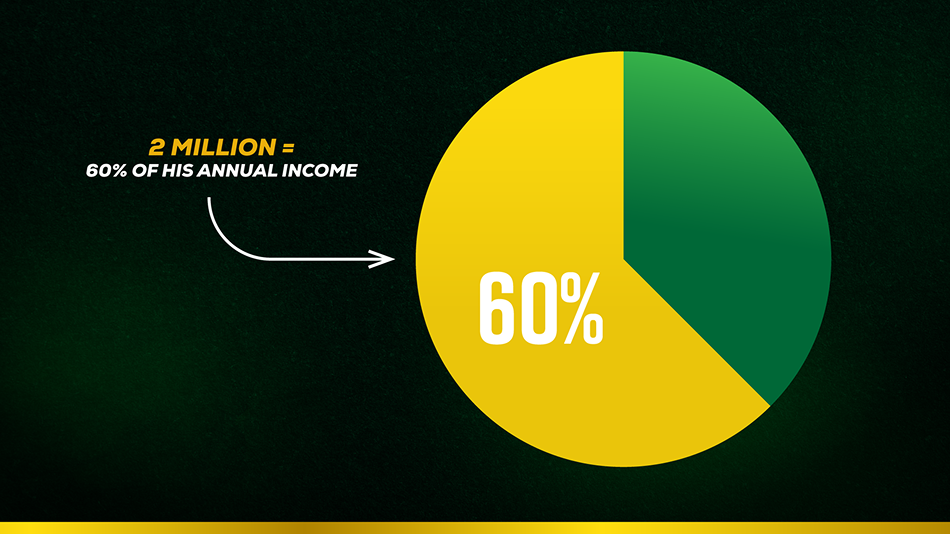
He was putting more than half his yearly income on the line.
That was the second piece. Real money conviction.
This wasn't a token buy to look good to the board.
This was a man making a life-changing bet because he believed, or rather, he knew that something was about to happen.
But in my line of work, you don't base your entire case on one data set. One insider can be wrong. One insider can be early.
One insider can be delusional. So I went back to the filings and what a coincidence. Three more insiders all buying within the same two-week window.
Different amounts, different titles, but all moving at the same time. Four insiders all betting on the same outcome.
All putting what would normally be considered too much of their own cash on the line. That was the third piece, aligned accumulation.
Insiders are legally prohibited from coordinating their trades. So when you see multiple executives all buying at once, it's not because they talked about it over lunch.
It's because the news spreading through the building is so undeniable, so obvious, that they're all independently reaching the same conclusion. Something big is coming.
But we don't know what yet. And that's not good enough for us. Most people don't know how to read a document. They skim. They assume. They guess.
So I pulled up the chart. I checked the volume. I looked at the options chain. The stock had stabilized. It wasn't dropping anymore.
And buyers were starting to show up. The technical picture was clean. The trade had to work in the real world.
If the stock was still in freefall, if there was no liquidity, if the options were mispriced, I would have walked away. But this one checked every box.
That was the fourth piece. Conditional execution. But I still didn't know why. So I decided to find out. I went through the company's recent patent filings.
I checked their customer contracts. I looked at their supply chain. I scoured industry blogs and niche forums.
And then I found it buried in a technical filing from two months earlier. The company had quietly secured a partnership with a major data center operator.
It wasn't in the headlines and it wasn't in the earnings call. But that partnership was guaranteed to triple their revenue within 6 months. The insiders knew it.
The market didn't. That was the fifth piece. keystone confirmation. Now I have the full picture. The timing, the conviction, the accumulation, the execution, and the confirmation.
I shared all of that with my readers in real time as I discovered it. Two weeks later, the stock exploded.
Lee Thomas Jong turned his $2 million into over $13 million. And anyone who read my report and followed his lead could have made a profit of 696%.
That's the T.R.A.C.K system.
Timing the turn:
Insiders buying at the bottom, not the top.
Real money conviction:
Big bets by people who can't afford to be wrong.
Aligned accumulation:
Multiple insiders moving at once.
Conditional execution:
The trade has to work in the real world.
Keystone confirmation:
The hidden catalyst that explains the why.
It's not a theory or a formula I pulled out of thin air. It's a roadmap I built from real trades, real wins, and real money.
When all five pieces line up, you know you're following a trail of evidence that leads to one conclusion. Something big is about to happen.
And if you take action, you could profit from it. Most people never figure out how to do this.
And even if they do figure it out, even fewer take action. I've made the system as simple as possible so anyone can understand it and follow along.
But it wasn't easy. When I studied investigative journalism at Northwestern, I saw very quickly that most people don't know how to read a document.
They skim, they assume, they guess and that's how the truth gets buried.
So I learned how to dig through court records and police files and find the details everyone else missed.
I learned how to talk to people to get the information I needed. And that work helped get two innocent men off death row.
Later,
when I worked on K Street — the street in Washington DC where the biggest and most influential lobbying advocacy groups and think tanks operate, I watched how laws, policies, regulation,
and money actually interact.
It's never random. You can predict outcomes if you know which documents to pull and what names to pay attention to. Then I went into competitive intelligence.
As Robert said, that's the polite term for corporate espionage. And that's where the real education began. I worked with analysts, hackers, and economists in more than 20 countries.
We mapped supply chains, tracked political risk, extracted data competitors didn't want us to see, and built models that show how companies behave and how money moves.
And then I got a graduate degree in global security from Johns Hopkins, an MBA in finance, and a master's in economics.
All of that experience, that background that Robert says makes me a financial 007, bleeds into the system I use today. People think Wall Street is built on secrets.
And yeah, it kind of is. But it really isn't because the information is there if you know where to find it and how to get it.
But most people don't know the information even exists, or where to find it. And they wouldn't know how to analyze it if they did find it.
I'm not reading tea leaves or looking at astrology charts or guessing where a stock might go.
I build a stack of evidence that gives me, Robert, and now you — if you want — an inside track that all the rat-race traders don't have.
That's how I've been able to compile a track record with an 83% win rate and 612% returns. So let's kick this off with your free stock pick.
Pick up a pen and pencil because I'm about to give you the name of what could be my next monster-sized winner.
Just watch what happens with the stock over the next few months and you'll see exactly how well this system works.
Now, usually when I use my track system, I'm watching insiders at the company I'm recommending. But this time, I did something different.
I tracked the insiders at one of their biggest customers. Let me show you what I found.Timing the turn. The sector was down. Analysts were bearish.
The stock had been cut in half. Then on December 4th, US Steel announced they were restarting a blast furnace at Granite City Works.
That furnace had been sitting idle since 2023. You don't restart a blast furnace casually. It takes months. You need suppliers lined up and crews trained.
The CEO said they reviewed customer demand and expected to run profitably into 2026.
When a steel maker fires up a furnace, they need a specific type of coal called metallurgical coal.
It's the high-quality coal that burns hot enough to forge steel in a blast furnace. There's no substitute for it.
Five days later, insiders at one of America's largest metallurgical coal producers started buying. Real money conviction.
Kenneth Cortis, a director at this coal company, bought $16 million worth of shares between December 8th and 15th.
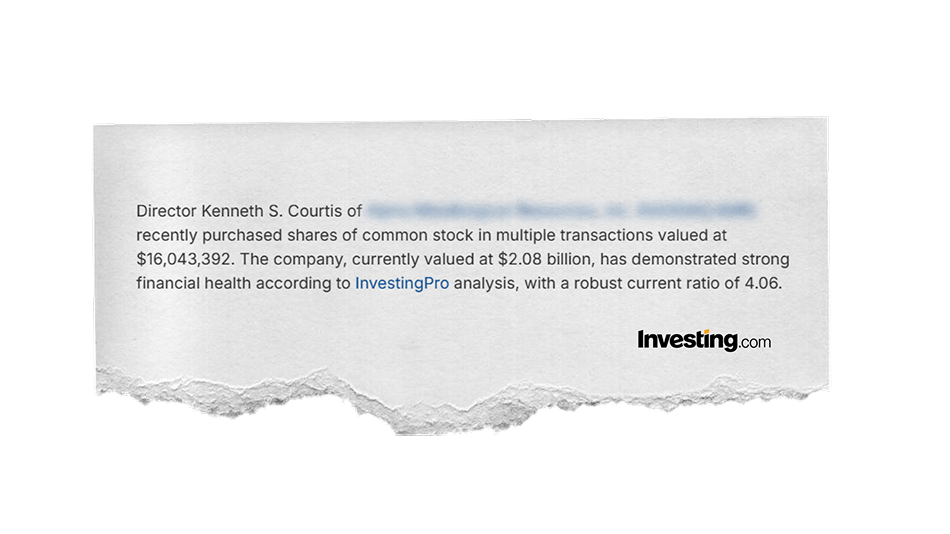
Michael Gorzinski, a 10% owner and director, bought another $7.3 million on December 15th. That's $25 million in personal money deployed in one week. Executives writing personal checks. Aligned accumulation.
One insider buying is interesting. Two insiders moving the same week with that kind of money is a signal. Cortis is a former vice chairman of Goldman Sachs Asia.
He spent decades reading markets. He's not buying this coal company because he likes coal. He's buying because he sees something in the order books.
Then Crocodile Capital filed in January showing $41 million in the same stock. They've traded this name before. They know the business.
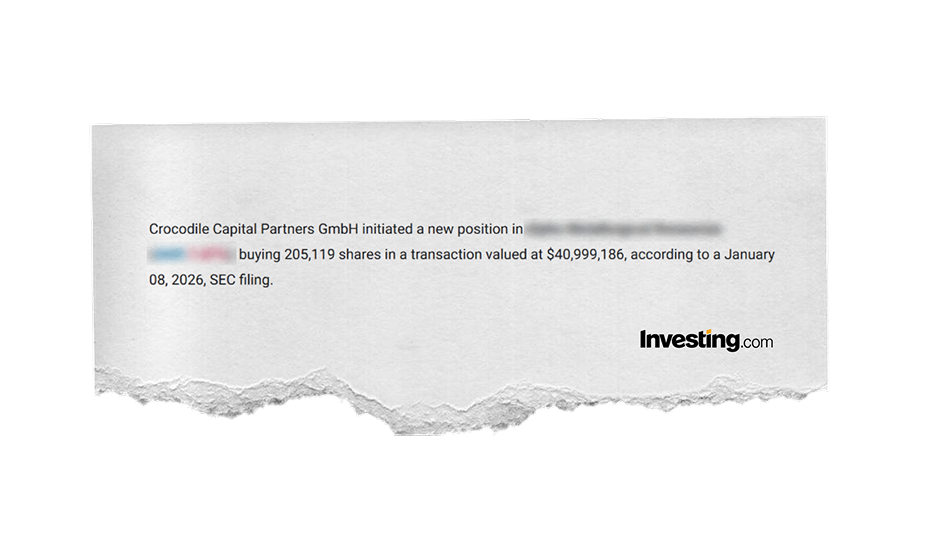
Three sophisticated buyers, same company, same window, all betting on the same outcome.
Conditional execution — Here's the key part. This coal company bears all the operating risk.
They deal with diesel costs, equipment breakdowns, payroll, safety inspections, workers' comp claims, and everything else. That's the mining business. Constant spending just to keep production where it is.
But there's another company in this equation that does not bear any of that risk. A company that just collects checks as long as the mines keep running.
Which brings us to keystone confirmation. That coal company doesn't own the land they mine. They lease it. They pay royalties to the company that owns the mineral rights.
And that company sits at the keystone position in the value chain.
They get paid first — before the coal company pays their diesel bills, before they make payroll, before they calculate their profits. The landlord gets the rent check.
And that landlord is the stock I'm giving you today. This company owns 13 million acres of mineral rights across America. They don't mine. They don't drill.
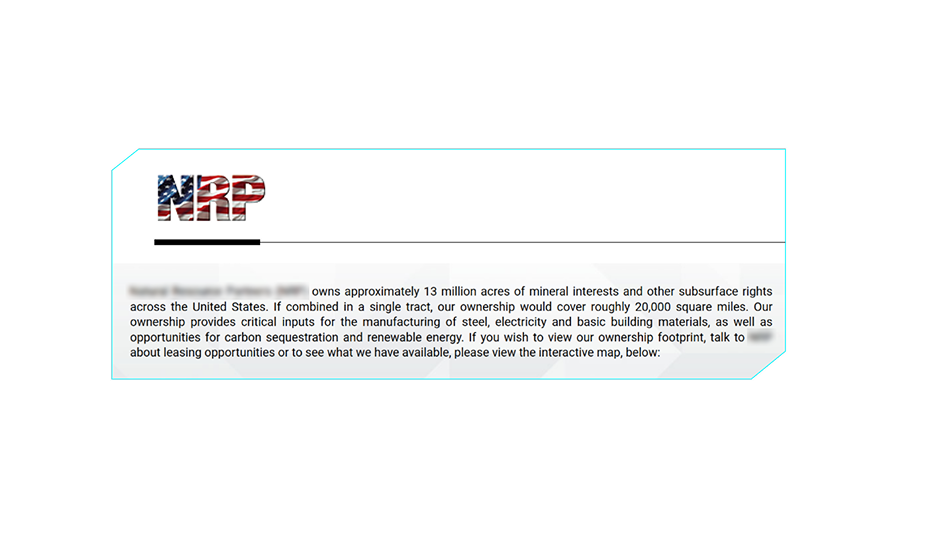
They don't operate equipment. They just collect royalties on everything that comes out of the ground.
It runs at an 85% free cash flow margin because they have almost no operating costs. And in the last 12 months, they've pocketed $190 million in free cash flow.
The company is Natural Resource Partners, ticker NRP. It trades on the New York Stock Exchange right now. Track it over the next few months.
Watch what happens when the coal company's insiders are proven right. Watch what happens when distributions start rising.
Then you'll understand what it's worth to get picks like this every week. Want another one? Here you go.
Now, let me tell you about the trade I'm most excited about.
This one's even bigger than NRP, and I'm sending out all the details as soon as this video ends.
But I'll tell you as much as I can about it now.
Before I show you who's been buying this company — which is shocking enough — you need to understand where this company is.
Most people have never heard of what is commonly called the quiet zone. And that's exactly the point. It's about a 3-hour drive from me, 180 miles southwest of Baltimore.
This isn't just any location. It's a fortress of silence.
A place where the federal government has made it literally illegal to transmit certain signals, where cell phones don't work, where Wi-Fi is restricted, and where the outside world can't see in.
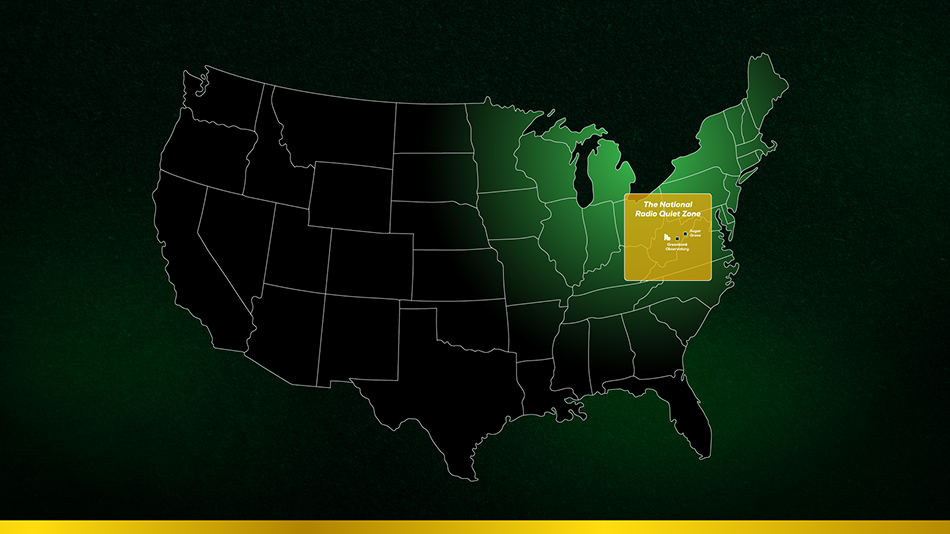
The full official name of this area is the National Radio Quiet Zone. I call it something else — a financial black site. It's the Area 51 of finance.
And right now, at the center of this government-protected dead zone, a tiny company is sitting on what could be the most explosive wealth-building opportunity in America.
The insiders know it. They've been quietly accumulating shares for months, hiding their moves in the one place the public can't easily track them — but I found them anyway.
And because they're an essential AI infrastructure company, it's even more surprising that they chose to base their operations there instead of Silicon Valley or some other booming tech corridor.
Because while everyone has been paying attention to AI software and chipmakers, the real story and the real prize is the physical infrastructure that moves data.
The high-capacity pathways that will carry the tidal wave of AI traffic no one is prepared for.
And this company controls one of those critical stretches right alongside the busiest data corridor in the Western Hemisphere — Loudoun County, Virginia.
That alone is interesting enough to get my attention.
And the money trail I uncovered is what turns this from an intriguing story into what could honestly be the profit opportunity of a lifetime.
But what really set off my alarms wasn't the location. It was the moment the buying started. It was just when the stock stopped making new lows.
Right when it hit one of those natural floor levels where selling pressure finally peters out and started to slightly turn higher.
That's when the first wave of serious money appeared — not after any major news like an earnings report or any other headline. That's always the tail.
Remember, we call that timing the turn. And these weren't symbolic buys.
The first signs came from enormous purchases by American pension funds — who by nature are conservative managers who oversee retirement money for teachers and state workers.
They don't burn their members' futures on hype. They don't take flyers. And they don't put seven-figure amounts into small overlooked companies unless they truly feel it.
These were real stakes put down by people who don't make decisions lightly. That's real money conviction. Then it got even more interesting.
A major Canadian pension-backed group showed up next. These institutions own highways, utilities, and long-term infrastructure across North America.
After that, a global infrastructure fund tied to a brand new $25 billion US partnership with Abu Dhabi began buying shares — but not all at once, because doing so would make headlines.
So they tried to hide their investment as best they could by buying in phases.
A little over $1 million worth at first, then several million more the very next month. Then another $641,000 the following week.
That's how large sophisticated investors build positions when they don't want to draw attention to what they're doing.
And when I see aligned accumulation from American pensions, Canadian pensions, and a globally connected infrastructure group all circling the same company in the same quarter
buying in patient, measured waves — that tells me something bigger could be forming.
So I kept tracking. And the stock itself behaved exactly the way I want to see it behave when that kind of money steps in.
It had already stopped falling and volume improved just enough to show there were real buyers available.
And once momentum turned, the stock held steady right around the levels where the first big buyer stepped in. So it checked off every one of my conditional execution parameters.
And that's when I knew this was looking like a real setup — not just any regular trade, but one that could be a life-changing, legacy-building one.
So I did what I do. I dug deep into research and discovered this company has one of the most brilliant business plans ever conceived.
And it checked off our final requirement — keystone confirmation — in a big way. The government is about to pay for most of this company's expansion.
Billions in federal and state broadband funds, rural deployment programs, and infrastructure grants are flowing directly into the kind of network this company specializes in.
Here's their business plan in two sentences.
Government dollars build the assets.
Private investors — that's us — collect the returns.
Not bad, right?
So what you have is a company headquartered inside a government-protected quiet zone.
Situated beside the most valuable data corridor in America.
About to receive massive publicly funded expansion support — protected by tax shields for years.
With American and Canadian pensions and an Abu Dhabi wealth fund all quietly accumulating right as the stock hits its natural bottom and turns higher, with perfect execution conditions and a hidden catalyst underneath it all that almost no one has connected.
None of this is a coincidence. And almost no one outside the filings has put the pieces together yet. We're still early.
So I put all of my research into an investment brief.
The money trail, the filings, the accumulation pattern, the subsidy timing, why these little-known company in the quiet zone is suddenly being surrounded by some of the most serious big-money investors on Earth.
And most importantly, the company name and stock ticker.
But this is not for the general public. It's not for sale and it's not available anywhere online. It's only for people who join Robert and me today.
And I'm sending it out as soon as this video ends. What you are about to receive may be the first true inside track advantage you've ever had.
• Charter Membership • Kiyosaki's Inside Track • Limited Availability •
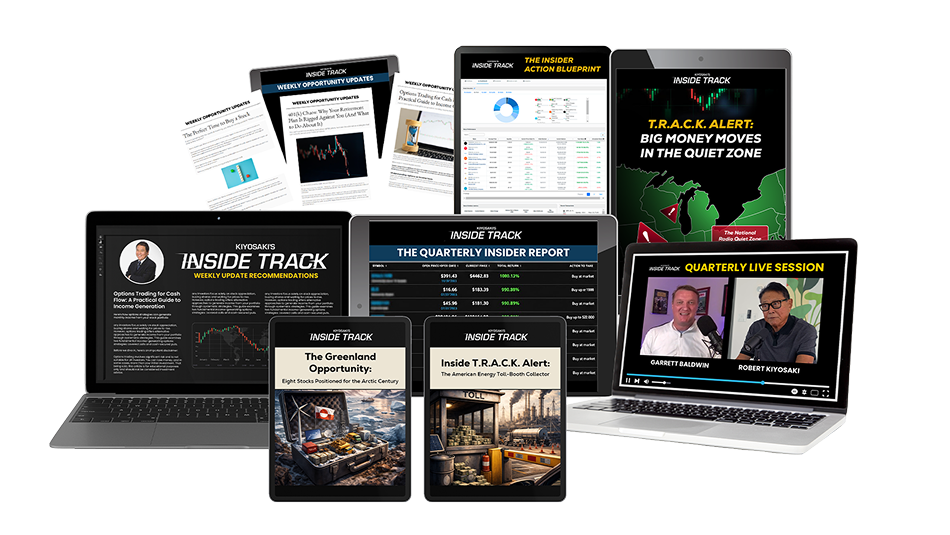
As soon as you join, I'll send you the trade report titled Inside Track Alert — Big Money Moves in the Quiet Zone.
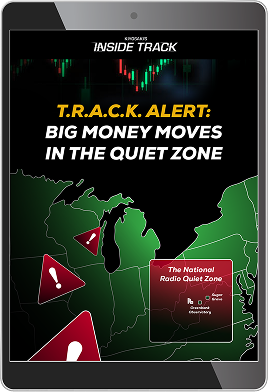
It explains the company positioned at the center of the quiet zone and why the most strategic money in the world is quietly accumulating shares.
You'll understand the full story before the rest of the market even knows there is one. But Robert and I have a surprise for you.
You already got your free pick, NRP, and you know about the company about to go on a tear in the quiet zone.
But there's another stock I've been tracking that could be just as big. This company quietly controls the pipelines moving natural gas across America.
And right now, the Trump administration just handed them what amounts to a government-mandated customer list. Here's what happened.
The White House announced they're forcing data centers to fund their own power generation through 15-year supply contracts.
If big tech is building new natural gas power plants to run AI data centers, that gas has to flow through someone's pipelines. This company owns those pipelines.
They don't drill. They don't take on unnecessary risk. They just move the gas and collect fees on every unit that flows through.
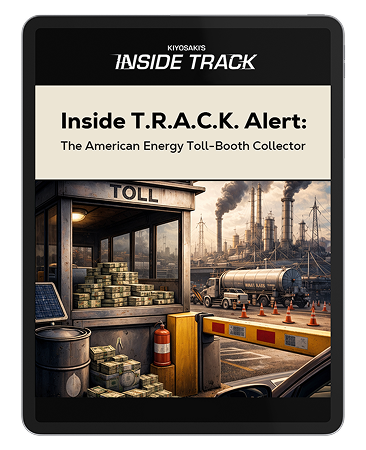
It's a toll booth on America's energy infrastructure. And insiders just started buying. Executives committing real personal capital right as this policy was being announced. They see the order books.
They know what's coming. Long-term contracts, locked-in cash flow, no way for customers to go around them.
You'll get the full breakdown on this company, the insider buying pattern, and exactly why this could deliver huge gains fast.
In a free bonus report titled Inside Track Alert — The American Energy Toll Booth Collector.
And there's something else I need to tell you about.
The moment you see how insider buying really works — and how the T.R.A.C.K. system lets you follow the most informed buyers in the world —
One buyer immediately stands apart from the rest.
The US government.
Think about it. When a CEO buys $2 million of his own stock, that's a strong signal.
But when the Pentagon takes a $400 million equity stake in a company and locks in decade-long pricing guarantees, that's an unmatched commitment and a near monopoly.
And the United States government is acting like an insider buyer right now — taking equity positions, extending massive financing, and locking in supply chains.
When that happens, these companies stop being ordinary stocks. They become too important to fail. So I started asking myself — where else is this pattern showing up?
Where is the government deploying capital that looks exactly like insider buying?
And I found eight companies all positioned around a single region that just became non-negotiable for US security and resource independence.
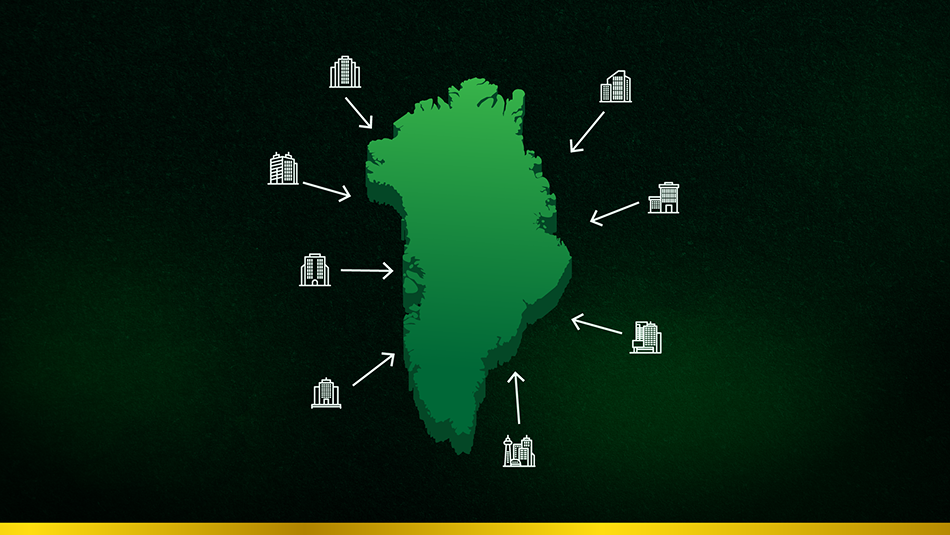
I'm talking about Greenland.
Now, before you laugh this off like the media first did in 2019 and again with Trump's latest Greenland play — let me show you what the capital flows actually look like.
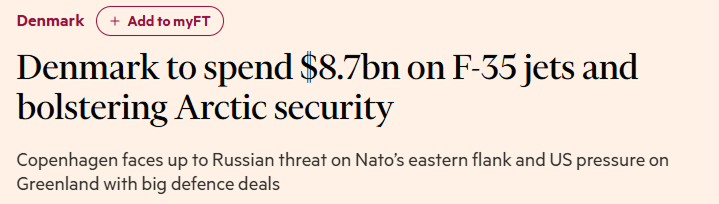
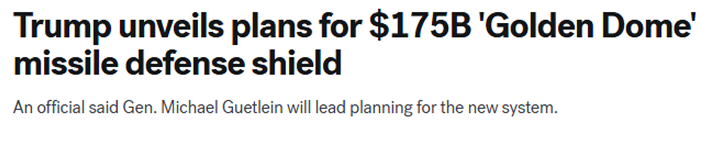
Denmark just committed $8.7 billion to Arctic defense. The Pentagon announced $175 billion for a missile defense system that explicitly relies on Greenland.
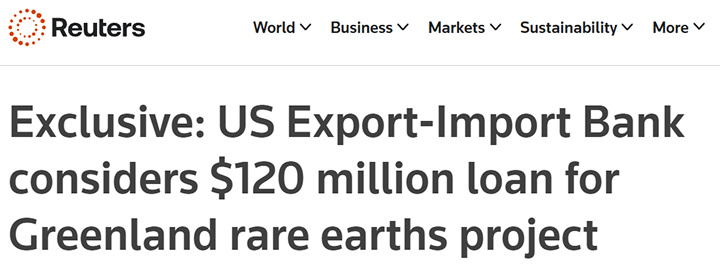
The Export-Import Bank issued over $100 million in financing commitments for Greenland resource development. This is what real capital deployment looks like.
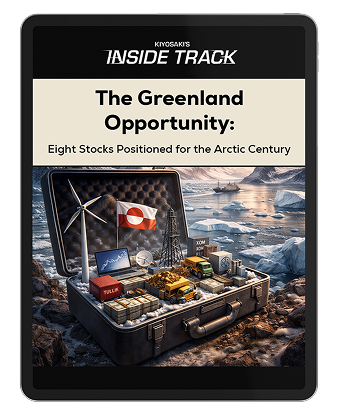
That's why I put together a full research report identifying the eight public companies positioned to benefit most from this government insider buying.
I call it the Greenland Opportunity — Eight Stocks Positioned for the Arctic Century.
These are real companies with real revenues, many paying dividends, that are positioned to benefit whether the US acquires Greenland outright or simply expands its strategic presence there.
Here's what's inside.
Three income-producing stocks that give you steady cash flow now and exposure to the Arctic without having to bet on anything speculative.
One is a global energy giant with six decades of experience operating in extreme cold and preferential access to future Arctic exploration opportunities.
Another builds the defense systems protecting every radar installation and missile battery the government is deploying north.
And the third operates America's nuclear shipbuilding capacity — and submarines are the only vessels that can project power under Arctic ice year round.
Three critical mineral stocks that benefit as the US breaks China's stranglehold on rare earths and strategic materials.
The first already has the Pentagon as a major shareholder with locked-in pricing for a decade.
Next, a company that operates the only facility in America capable of processing heavy rare earths at scale.
And a smaller, under-the-radar company tied to a material where China controls more than 90% of global supply and has now restricted exports to the US.
Plus two direct Greenland plays for aggressive investors who want pure exposure.
There's a specialized Arctic shipping operator that can navigate frozen waters year round — meaning they earn premium rates because most shippers simply can't operate there.
And finally, a frontier oil developer preparing to drill a basin studied extensively decades ago but never developed — with its first well scheduled for this summer.
Each company gets a full breakdown. You'll read the strategic rationale behind each pick. I'll show you the government money already committed.
We'll go into the risk level so you can size your positions appropriately. And I'll give you specific buy-up-to prices.
This is about understanding how capital actually moves when national priorities are involved.
When the government decides it needs something, it doesn't negotiate with the market.
It deploys capital and makes damn sure it happens.
That's how asymmetric opportunities are created.
Most investors will only notice these companies after it's already obvious.
You're getting the full research now — while it's still quiet.
You'll receive the Greenland Opportunity — Eight Stocks Positioned for the Arctic Century — as another bonus when you join today.
Now, let me show you everything else that's included.
Weekly trade recommendations. Not all picks are winners, and past performance is not an assurance of future results.
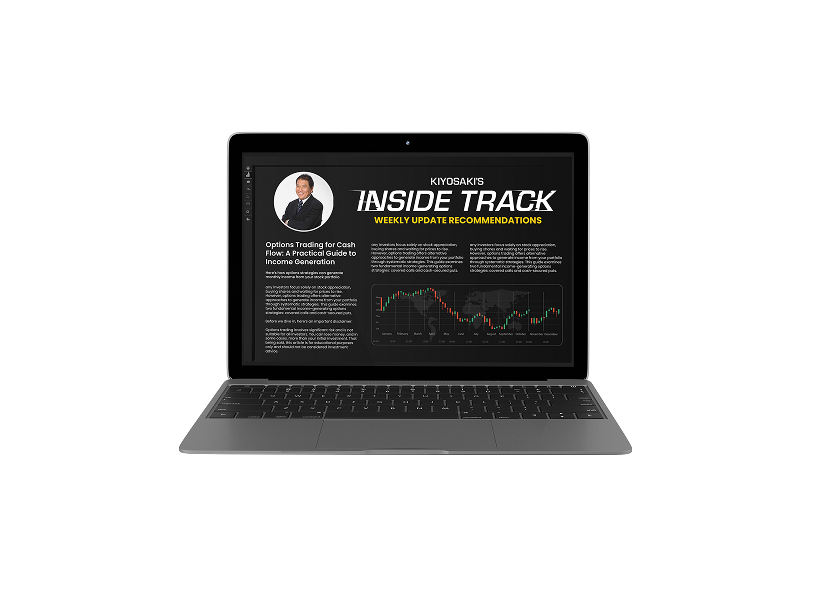
But once you're inside with us, I'll keep bringing you the same kind of opportunities that created gains like the 696% moonshot from BMNR you saw earlier.
Roughly one per week — around 52 a year. I say "roughly" because I'll never send out forced recommendations. Some weeks there may be no really great inside track opportunities.
In some weeks there may be more than one. But when they are there, I move fast. You don't have to take every trade recommendation.
But when you do, you'll know you're moving with the people who move the market.
The quarterly insider report. Every quarter, I walk you through the five biggest insider buys of the last three months.
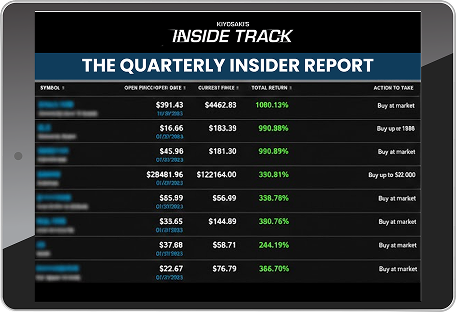
These are the heavy hitters who committed serious money because they believed the timing was right. And here's where it gets interesting.
A lot of times when insiders make big buys, they're committed for six months. And that gives us a rare advantage.
By the time we review these buys each quarter, we're halfway through that window. So we get a second look with far more information than we had on day one.
We can see how the stock behaved since they stepped in. We can see how the story evolved.
And we can judge whether the opportunity is even better now than it was when they wrote the check. Some of the best trades come from these second looks.
Quarterly live session. Once a quarter, we sit down and go through the filings together on a live stream. I pull up what's new.
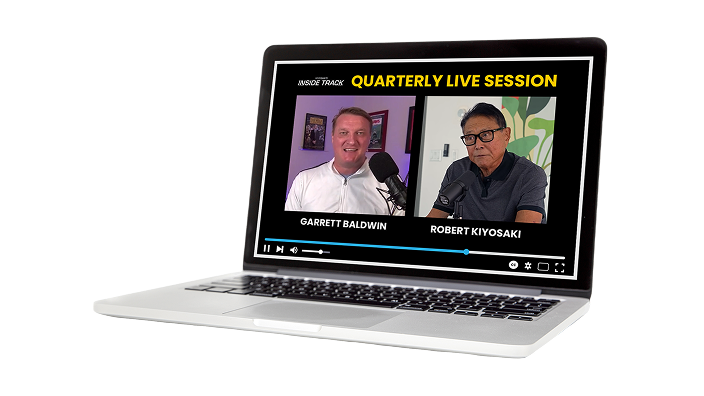
I show you what insiders are doing right now. I break down which patterns are forming, which sectors are waking up, and which trades I'm preparing for next.
Maybe even access to live satellite streams to check out a company we have our eyes on. The middle class never gets to see how real money gets analyzed.
You will.
Weekly opportunity updates. The market moves fast and insiders move even faster.
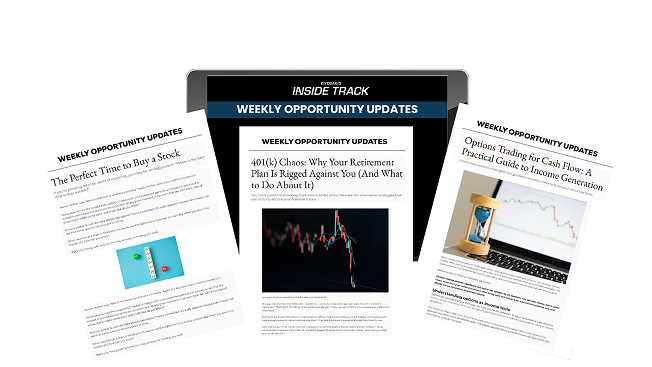
That's why you'll get short, clear updates every seven to ten days to keep you plugged into everything important.
New insider buys, new activist filings, new signals quietly forming under the surface. Anything that could turn into a real trade. You always know what's shifting.
You always know what deserves a closer look.
And when something's heating up, you see it early enough to actually take advantage of it — not see the headlines about it after it's already gone.
Your access is granted. Just walk through the door.
The Annani Club charges a $200,000 initiation fee, then another $15,000 every year.
The Executive Branch in Washington DC — co-founded by Don Jr. — costs $500,000 just to get in. Mar-a-Lago, President Trump's residence — the initiation fee is $1 million.
Those clubs give you social access and access to rooms where powerful people talk. This one gives you something different.
Laser-focused financial research and profit opportunities — by following the stock market moves of those very same people. It gives you an early advantage you've never had before.
You'll see the signals insiders rely on, and you'll know how to act on them.
You'll use a process that follows what real money does — not what commentators say after the move is over.
And the cost to join isn't even close to those elite clubs. Not in the same universe.
But frankly, if we did charge that much, it would be well worth it — with the level of insider access to money-making moves you'll be getting.
Let's do a quick recap because there's a lot going on.
As soon as this video ends, I'm sending out Inside Track Alert — Big Money Moves in the Quiet Zone — to the first round of members.
You'll also get Bonus Report #1 — Inside Track Alert: The American Energy Toll Booth Collector.
And Bonus Report #2 — The Greenland Opportunity: Eight Stocks Positioned for the Arctic Century.
Then over the course of the next year, I'll send out somewhere around 48 to 52 different trade recommendations that could be just as big or bigger.
And you'll get the quarterly insider report where we review the five biggest insider buys of the last three months and see if there's a second-look trade we can take.
Plus, once a quarter, we'll sit down and go through the filings together on a live stream — so you can see and analyze the inside money in real time.
And opportunity updates every seven to ten days, whenever something heats up and we might have to act fast to grab a big profit.
I didn't mention these earlier, but I'm also going to send you something I put together for people who really want to see how this works behind the scenes.
It's called the Insider Action Blueprint.
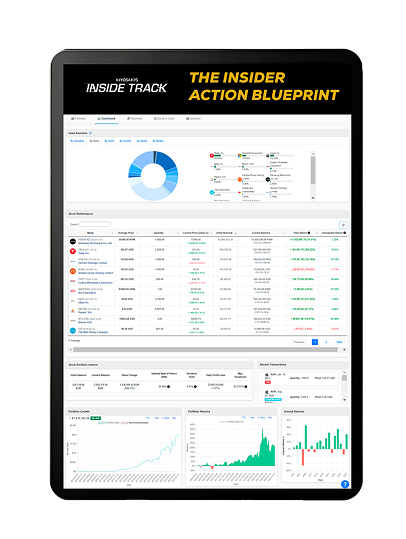
Inside it, I walk you through the three main ways I trade insider activity. You'll see how to spot fast-moving catalysts the moment fresh insider signals hit the tape.
How momentum unfolds over the next one to three weeks and how to trade those short, clean windows.
And how to identify multi-month insider campaigns where the smartest executives quietly reshape a company from the inside out. It's extensive, but it's nothing complicated.
Even if you just skim it, you'll totally understand how each setup works and how I turn insider buying information into real, actionable trades.
You're getting all of that today. And you're also getting the Ironclad 90-Day Performance Guarantee.
I am so confident in the power of the track system that I am prepared to make you a guarantee that no one else in this business dares to make.
I want you to take the next 90 days — a full three months — and put Inside Track to the test.
Get the quiet zone report, follow the weekly trade recommendations, and see for yourself the advantage that comes from having a financial 007 on your side.
If at the end of those 90 days you are not 100% satisfied with the performance of my recommendations and the quality of your research — I don't want you to be out a single penny.
Simply contact my friendly member services team and we will issue you a full 100% credit for every dollar you paid.
You can apply this credit to any other research service, product, or event from Kiyosaki Research. No questions. No hassles. Why do we do this?
Because my commitment is to your financial education and success.
If Inside Track isn't the perfect fit for your goals, I want to give you the power to find the one that is. This ensures you can't make a mistake.
You either win with Inside Track — or you get to reallocate your entire investment into another area of your financial journey, on my dime.
Now, you could do this yourself. Just get on the SEC.gov website and download all the insider forms filed in the last 24 hours.
Remember — there are usually around 4,700 of them.
Go through the trades and only pick the ones where there is aligned accumulation and the size of the trade is big enough to show conviction.
Then check some chart patterns — global liquidity, volume, and moving averages.
And if all that looks good, make sure you do some research into the business fundamentals to make sure you're looking at a company with strong numbers.
If all that looks good — rock and roll. Buy some shares. And do all of that every single day.
Or you come into the club and say, "Hey Garrett, any good trades today?" And I say, "Yep." And tell you all about the trade I've just finished researching.
Actually, once you're in the club, you don't even have to ask.
I'll just send them to you — with all my research and reasoning — and you can decide to place it or not.
If you had done that over the last year, you would have made a 612% return on your money.
And now the decision is in your hands.
I'm not going to pressure you — because you just have to answer one simple question.
This video is about to end.
And as soon as it does, I'm sending out Inside Track Alert — Big Money Moves in the Quiet Zone — to the first round of members.
I'd like to send it to you.
I'd like to send you Inside Track Alert — The American Energy Toll Booth Collector — and the Greenland Opportunity — Eight Stocks Positioned for the Arctic Century.
Do you want them?
If you do — click the button and join the club.
Robert has already done everything he can to make this an easy decision for you.
For the next year, I'll do everything I can to help you get out of the rat race and into financial freedom.
Click the button on your screen now — and we'll be off to the races.
Your Investment
Annual Charter Membership
$1,495/year
per year · all reports · weekly trades · live sessions
Secure order • Instant access • 90-Day Ironclad Guarantee
The Ironclad 90-Day Performance Guarantee
Take 90 full days and put Inside Track to the test. Follow the recommendations. Track the results. If at the end of those 90 days you are not 100% satisfied, we will issue a full 100% credit for every dollar paid — applicable to any Kiyosaki Research product. No questions. No hassles. No fine print.
Robert Kiyosaki & Garrett Baldwin
Kiyosaki's Inside Track — Charter Membership